
60-Second Answer (URGENT — Deadline Sensitive)
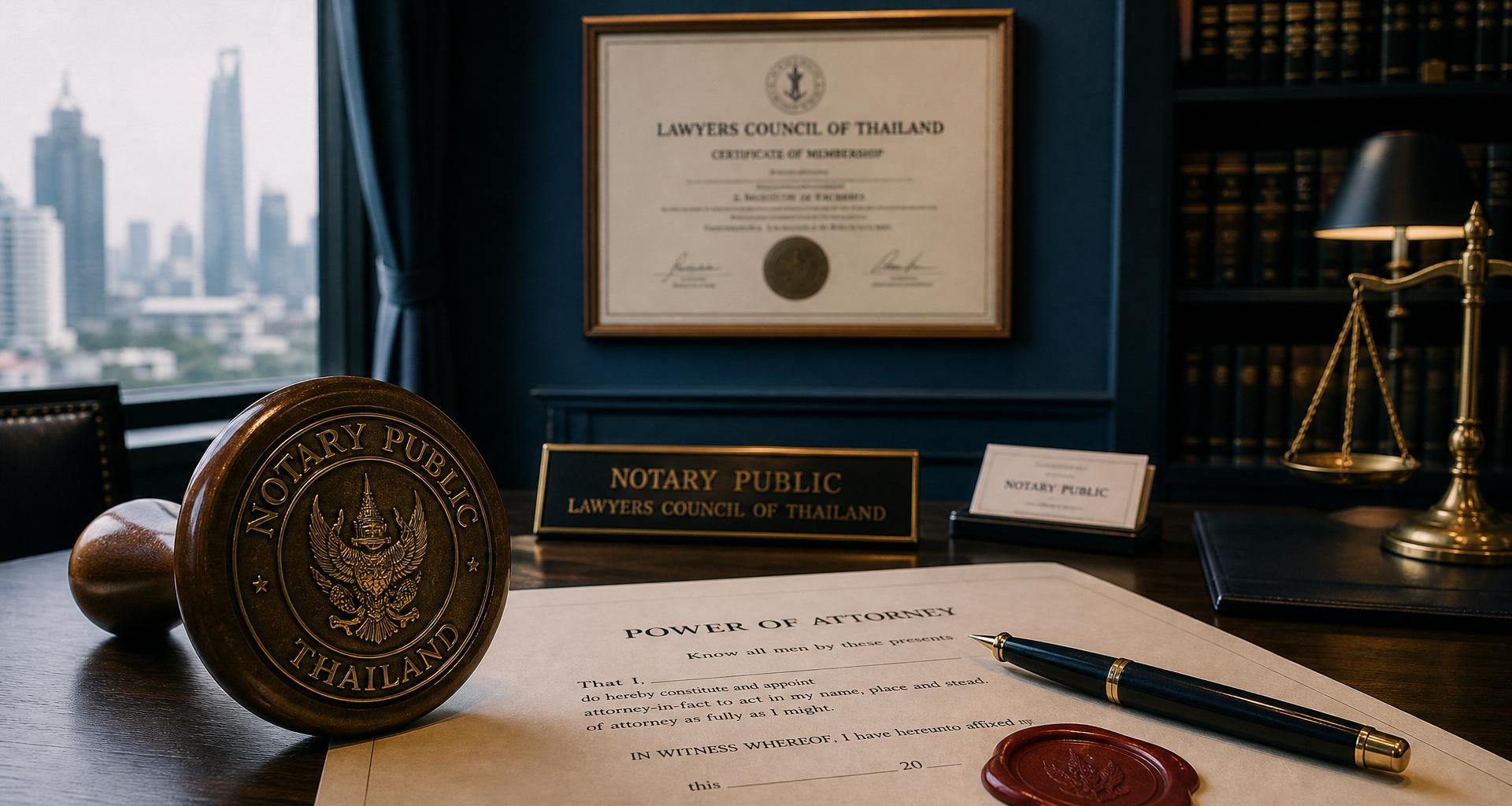
iVC provides Notarial Protest of Instruments in Bangkok for dishonored cheques, bills of exchange, and promissory notes — preserves your right to sue the drawer and all endorsers in international courts. CRITICAL: file within 24-48 hours of dishonor under Thai CCC, UK Bills of Exchange Act 1882, Singapore/HK BoE Ordinance — failure to protest = loss of recourse against endorsers. Our Lawyers Council of Thailand Notarial Services Attorney executes formal Protest + Notice of Dishonor, then Apostille at MOFA (post-Hague 2026) for direct admission as prima facie evidence in 125 Hague country courts. Standard 5,500 THB, urgent same-day +50%, full international package (Protest + Apostille + DHL to UK/SG/HK solicitor) 11,500-14,500 THB. Turnaround 24-72 hours for Protest, 5-7 days for full international filing.
FAQ
What is a Notarial Protest of Instruments and when do I need it?
A Notarial Protest of Instruments (also called Protest for Non-Payment or Protest for Non-Acceptance) is a formal notarial act under the Bills of Exchange Act and international Geneva Convention on Bills of Exchange (1930) where a Notary Public formally records that a negotiable instrument — bill of exchange, promissory note, cheque, or banker's draft — has been presented for payment/acceptance and dishonored. The protest creates prima facie evidence in court proceedings (Thai and foreign) that the drawer/maker and all endorsers are liable. You need it when: (1) a foreign customer's USD/EUR cheque to your Thai company is dishonored ('Refer to Drawer' / 'Insufficient Funds' / 'Stop Payment'); (2) a bill of exchange drawn on a London/Singapore/HK bank is dishonored on presentation; (3) a promissory note issued by a foreign party for a Thai loan is not paid at maturity; (4) you need to preserve recourse rights against endorsers (without protest within 24-48 hours of dishonor, recourse against endorsers may be lost under foreign laws); (5) you intend to sue in a foreign court (UK, HK, Singapore, US — all common law jurisdictions require notarial protest for international bills).
What is the legal deadline to file a Protest after dishonor?
Critical deadlines vary by jurisdiction and instrument type: (1) Thai Civil & Commercial Code (Section 982-987) — protest must be made on the day of dishonor OR the next business day for inland bills; foreign bills have until the next business day after the day for presentment for acceptance/payment — failure to protest within deadline = loss of recourse against endorsers (drawer remains liable) (2) UK Bills of Exchange Act 1882 — foreign bills MUST be protested for non-acceptance/non-payment on the day of dishonor or the next business day (3) US UCC Article 3 — protest not strictly required for domestic, but international convention/contract usually requires it (4) Geneva Convention 1930 (UNIDROIT) — applies to most European bills, requires protest within 2 business days of dishonor (5) Singapore Bills of Exchange Act — same as UK pattern (6) Hong Kong Bills of Exchange Ordinance — same as UK. iVC recommendation: file protest within 24 hours of dishonor regardless of jurisdiction — preserves all options. We offer same-day urgent protest service for time-critical instruments.
What documents and information do I need to bring to iVC?
Required for Protest filing: (1) Original dishonored instrument (cheque/bill/note) — must bring physical original, not a copy (2) Bank's dishonor advice / return memo — written notice from drawee bank stating reason for dishonor ('Refer to Drawer', 'Insufficient Funds', 'Stop Payment', 'Account Closed', 'Signature Differs') (3) Original face deposit slip / presentation receipt — proves date of presentation (4) Holder's identification — passport + proof of corporate authority if held by company (5) Underlying contract — sales contract, invoice, or loan agreement showing why the instrument was issued (6) Endorsement chain — list of all endorsers if instrument was negotiated multiple times (7) Drawer's last known address — for service of protest notice. iVC drafts: (a) formal Notarial Protest Certificate; (b) Notice of Dishonor to drawer + endorsers; (c) cover letter for foreign court filing; (d) Apostille-ready format for cross-border enforcement.
What is the difference between Protest for Non-Acceptance vs Non-Payment?
Two distinct protest types under bills of exchange law: (1) Protest for Non-Acceptance — applies ONLY to bills of exchange (not cheques) — when a bill is presented to the drawee for acceptance and the drawee refuses to accept (refuses to commit to pay at maturity). Filed immediately on refusal. Preserves right to immediate recourse against drawer/endorsers BEFORE maturity date (2) Protest for Non-Payment — applies to all instruments (cheques, bills, notes) — when instrument is presented at maturity for payment and payment is refused. Filed on day of dishonor or next business day. Preserves right to recover principal + interest + costs from drawer/endorsers. Practical scenarios: dishonored cheque = Protest for Non-Payment (cheques are payable on demand, no acceptance stage). Bill of exchange drawn 90 days after sight, drawee refuses to accept on presentment = Protest for Non-Acceptance + later Protest for Non-Payment if not paid. iVC files BOTH protests on the same instrument when applicable — required for full international recourse.
How does Apostille (post-Hague 2026) help international debt recovery?
Major workflow improvement since 1 Jan 2026 for cross-border debt recovery: (1) iVC issues Notarial Protest under Lawyers Council of Thailand seal (2) MOFA Chaeng Watthana Apostille — single stamp — accepted in 125 Hague countries as prima facie evidence in court without further authentication (3) File suit in foreign court (UK High Court, Singapore High Court, HK Court of First Instance, Australian Federal Court) with Apostilled Protest as evidence. Pre-2026 workflow required: Protest → MOFA → destination embassy in Bangkok → DHL → foreign court — taking 14-28 days. Post-2026 (now): Protest → MOFA Apostille → DHL → foreign court — 5-7 days. Hague countries enforcing this: UK, Singapore, HK, Australia, NZ, US, Canada, Germany, France, Italy, Spain, Netherlands, Belgium, Switzerland, Japan, South Korea, India, Brazil, Mexico, Argentina, South Africa, UAE (post-2014). Non-Hague enforcement (China, Vietnam, Saudi Arabia): still requires embassy legalization + may need separate sworn statement under foreign attorney.
Pricing and turnaround for urgent international debt recovery
Notarial Protest fees: (1) Standard Protest for Non-Payment (single instrument): 5,500 THB — includes drafting, notarial act, 3 originals, Notice of Dishonor (2) Protest for Non-Acceptance + Non-Payment (combined): 8,500 THB (3) Multi-instrument batch (5+ cheques from same drawer): 4,500 THB each (4) Urgent same-day protest (within 24 hours): +50% surcharge (essential for preserving recourse). Apostille add-on: 1,500-2,500 THB + 3-5 working days (urgent same-day Apostille +50%). Non-Hague embassy legalization: 3,500-5,500 THB + 5-10 days. Foreign attorney coordination (UK solicitor, Singapore/HK barrister, US attorney for court filing): iVC has direct partners — coordination fee 5,500 THB + foreign attorney's own fees. DHL international courier: 2,500-3,500 THB. Typical full package (Protest + Apostille + DHL to UK solicitor): 11,500-14,500 THB + foreign attorney fees. Turnaround 24-72 hours for Protest + 5-7 days end-to-end including Apostille.